Visar inlägg med etikett craters. Visa alla inlägg

onsdag 26 augusti 2026

A very low moon

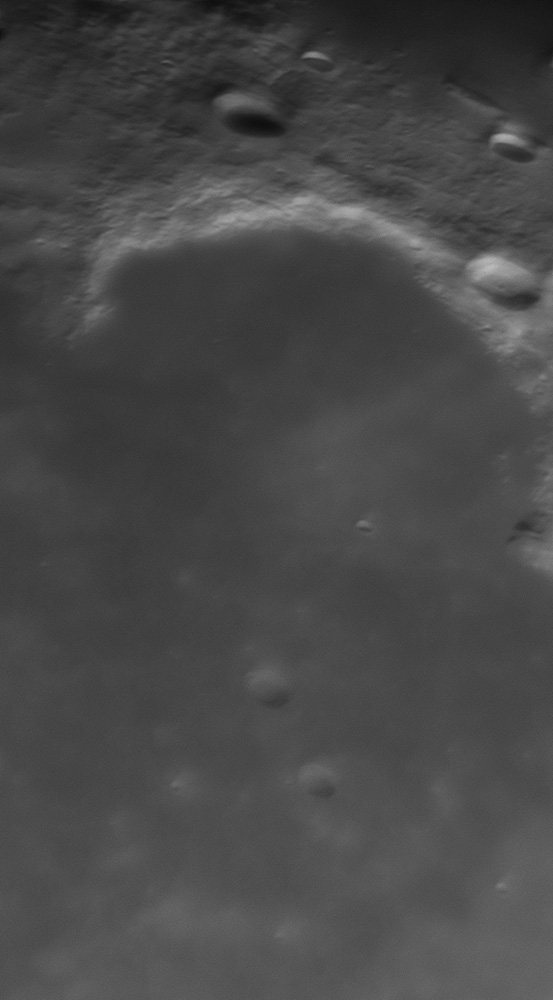
A very low moon in the sky, barely visible from the observatory. I didn't think there would be any sharp pictures but they turned out better than I thought. I just managed to take a picture of the moon before it disappeared behind the trees.

The close-up shows the crater Gassendi is a large lunar impact crater feature located at the northern edge of Mare Humorum. The crater was named after French astronomer Pierre Gassendi by the IAU in 1935.


lördag 7 mars 2026

The dark spots you see on the moon are actually giant, solidified lava fields called maria. These were formed billions of years ago when huge amounts of liquid lava gushed out of the moon's interior and filled large craters after meteorite impacts.

Composition: The fields are mainly composed of basalt, a dark, iron-rich volcanic rock similar to that found on the ocean floor here on Earth.

Volcanic activity: It was long thought that volcanism on the moon died out billions of years ago, but new analyses of lunar samples suggest that there may have been active volcanoes as recently as 120 million years ago.

Lava tubes: Beneath the surface are hollow lava tunnels, or lava tubes. These giant caverns are considered ideal locations for future lunar bases because they protect against radiation and extreme temperatures.

Asymmetry: There are significantly more and larger lava fields on the side of the moon that faces Earth than on the far side, which is because the crust is thinner on the front side.


lördag 10 januari 2026

Good seeing watching the moon

Very good view through the telescope when I looked at the moon the other week. At the top is Montes Jura, it surrounds the smooth lava bed Sinus Iridum (Bay of Rainbows) on the northwestern edge of Mare Imbrium (Sea of ​​Rain). A little to the south is the mountain range Montes Recti where the highest peaks reach a height of about 1.8 km (Latin for "Straight Mountains") is a distinctive, linear mountain range on the moon, located in the northern part of Mare Imbrium. Below are the mountains Montes Teneriffa (Tenerife Mountains) with individual peaks at heights of up to 2.4 kilometers. The crater Plato (in Swedish often called Platon) is one of the moon's most famous and easily recognizable impact craters. It is particularly famous for its dark, flat bottom and its location at the edge of one of the large lunar oceans. Plato has one of the darkest surfaces on the moon because it is filled with old, solidified basaltic lava. Astronomers like Johannes Hevelius once called it "The Great Black Lake"


måndag 29 december 2025

74% moon


Opened up the observatory and started to adjust the focus, connect the camera etc. and had just started taking pictures when heavy snowstorms came. But between these I was able to take pictures of tonight's moon which was 74% full. In the pictures you can see large craters like Copernicus, Plato, Archimedes and lava fields like Mare Imbrium with high mountain ranges Montes Alpes. Montes Alpes (Lunar Alps) is a prominent mountain range on the northern side of the moon, named after the Alps on Earth, and known for its highest mountain, Mons Blanc (3,600 m), and the impressive valley Vallis Alpes. The chain extends for about 220 km in a crescent shape, with a part bordering the lunar sea Mare Imbrium, and is one of the moon's most distinctive formations. Vallis Alpes is a lunar valley that divides the Montes Alpes area into two parts. It extends 166 km from the Mare Imbrium basin and trends east-northeast to the edge of Mare Frigoris. The valley is narrow at both ends and widens to a maximum width of about 10 km along the midsection. Copernicus is a prominent impact crater on the Moon located in the eastern Oceanus Procellarum. The crater is 96 km in diameter and 3.8 km deep. According to samples taken by Apollo 12 astronauts, the crater is about 800 million years old.