Visar inlägg med etikett moon. Visa alla inlägg

måndag 6 april 2026

Moon and Jupiter


A clear night in the Swedish mountains where the starry sky is free from light pollution. The bright planet Jupiter lies to the left of the moon this evening with the stars Castor and Pollux obliquely up to the left of Jupiter. Obliquely up to the right of the moon is the star Capella in the constellation Auriga. Below the moon and Jupiter is the constellation Orion with the bright star Sirius far down to the left. Around the moon are thin clouds that almost create a complete halo.

tisdag 31 mars 2026

Fantastic Aurora display

A magical night in the Swedish mountains. It started as a green glow in the north that developed into an arc that then increased in strength and went higher in the sky, finally to the zenith with curving green waves of light. The green glow flashed across the entire sky as if the atmosphere was shaking.

The northern lights (aurora borealis) affect the Earth's atmosphere, mainly in the upper layers such as the thermosphere and the ionosphere. The phenomenon occurs when charged particles from the sun collide with oxygen and nitrogen in the atmosphere at the magnetic poles. Main effects of the northern lights on the atmosphere: Energy input and heating: The northern lights are the result of an enormous energy input from the solar wind to the atmosphere. This causes local heating in the upper layers of the atmosphere. Electric currents: In connection with the northern lights, strong electric currents arise in the atmosphere, so-called auroral electrojet streams. These currents can affect the Earth's magnetic field. Ionosphere disturbances: Aurora activity can affect the ionosphere (the part of the atmosphere that is ionized), which in turn can disrupt radio communications and satellite navigation. Faint moonlight via a fine crescent moon and bright planet Jupiter also visible.


lördag 7 mars 2026

The dark spots you see on the moon are actually giant, solidified lava fields called maria. These were formed billions of years ago when huge amounts of liquid lava gushed out of the moon's interior and filled large craters after meteorite impacts.

Composition: The fields are mainly composed of basalt, a dark, iron-rich volcanic rock similar to that found on the ocean floor here on Earth.

Volcanic activity: It was long thought that volcanism on the moon died out billions of years ago, but new analyses of lunar samples suggest that there may have been active volcanoes as recently as 120 million years ago.

Lava tubes: Beneath the surface are hollow lava tunnels, or lava tubes. These giant caverns are considered ideal locations for future lunar bases because they protect against radiation and extreme temperatures.

Asymmetry: There are significantly more and larger lava fields on the side of the moon that faces Earth than on the far side, which is because the crust is thinner on the front side.


tisdag 3 mars 2026

Worm Moon HDR

Today's full moon, called a worm moon, photographed with a telescope and several images stitched together into one image.

At a full moon, the sun illuminates the lunar surface directly from the front, which hides shadows and makes it more difficult to distinguish topographical details such as craters and mountain walls. The use of HDR photography (High Dynamic Range) and stacking (combining many images) is therefore crucial to highlight geological contrasts and mineral variations that are otherwise lost in the bright light.

Geological details at a full moon

Beam systems: At a full moon, bright beam systems appear most clearly, for example from the crater Copernicus. These consist of material (ejecta) that was thrown out during a meteorite impact.

Albedo and minerals: The contrast between the light, calcium-rich highlands (anorthosite) and the dark, iron-rich oceans (basaltic maria) becomes extremely clear. By saturating the colors in an HDR image (so-called "Mineral Moon"), chemical differences in the soil can be visualized.

Bright Craters: Craters with high albedo, such as Aristarchus, shine brightly and can even be seen with the naked eye.


måndag 2 mars 2026

99% moon and the bird

The full moon is slowly rising in the sky, well, almost full, 99% behind a tree with a blackbird sitting at the top.

Tomorrow, 3/3, a total lunar eclipse will occur. The eclipse will be completely visible over northeastern and northwestern North America and the central Pacific Ocean and will be visible rising over large parts of Asia and Australia and setting over North and South America, unfortunately not from Sweden.


tisdag 24 februari 2026

A quick look at the moon

A quick visit to the Carpe Noctem Observatory tonight. It cleared up and I managed to take a quick photo of the moon before fog clouds ruined the session.

The picture shows beautiful mountain ranges on the right side of the Mare Imbrium lava field.

The top mountain range is the Montes Alpes, one of the most distinctive mountain ranges on the moon, located between Mare Imbrium and Mare Frigoris. It stretches for about 250 km and is best known for being literally split in half by an enormous valley.

Important peaks and landmarks

Mont Blanc: The highest point of the mountain range, located on the eastern side, with an altitude of about 3,600 meters. The name is taken from the highest mountain on Earth in the European Alps.

Vallat Alpes (Alpine Valley): The most spectacular formation in the area. It is a straight, 166 km long and about 10 km wide trough that cuts straight through the chain. It is a favorite for amateur astronomers to observe.

Promontory Agassiz: A headland at the southern end of the chain, rising about 2,300 meters.

Below the Alps and the Caucasus Mountains" most often refers to the lunar mountain range named after the Caucasus Mountains on Earth. These mountains lie on the northern part of the lunar far side and form a boundary between Mare Imbrium and Mare Serenitatis.

Peaks of the Lunar Montes Caucasus

Unlike Earth's mountain ranges, most individual peaks in the lunar Montes Caucasus do not have official names.

Highest peak: The highest point reaches an elevation of about 6,000 meters (19,000–20,000 ft) above the surrounding lunar surface.

Geographical location: The mountain range extends for about 445 km and is located near prominent craters such as Aristillus, Autolycus, and Calippus.

Below lies the beautiful Montes Apenninus mountain range, the most impressive mountain range on the lunar far side. It extends for about 600–950 km and forms the southeastern rim of the giant impact hole Mare Imbrium.

The Most Prominent Peaks

Here are the highest and most famous named peaks in order from north to south:

Mons Hadley: A massive peak at the northern end of the range, with an elevation of about 4,500–4,800 meters.

Mons Hadley Delta: Located south of Mons Hadley and is about 3,500–3,600 meters high. The valley between these two mountains was the landing site of Apollo 15 in 1971.

Mons Bradley: Located further south with an elevation of about 4,200 meters.

Mons Huygens: The highest peak of the range (and often considered the moon's) rising about 5,300–5,500 meters above the surrounding plains.

Mons Ampère: A peak west of Mons Huygens with an elevation of about 3,000 meters.

Mons Wolff: Marks the southwestern end of the range near the crater Eratosthenes and reaches about 3,500 meters


söndag 22 februari 2026

Pine lichen and crescent moon

Fluorescent lichens and moss on a pine tree by illuminating with UV light.

Lichens on trees are usually completely harmless and are not a sign of disease. They only use the tree as a foothold and do not take nutrition from it. The lichens indicate clean air and serve as homes for insects, which attracts small birds.

Key facts about lichens on trees:

No harm: Lichens do not penetrate the bark, do not cause rot and do not harm the growth of the tree.

Epiphytes: They grow as so-called epiphytes, mainly on older trees, and get nutrition from water and air.

Air quality: Abundant occurrence of lichens is a sign of a good air environment.

Common types: Examples are leaf lichens such as lung lichen, beard lichen and crust lichen.

Ecological benefit: Lichens provide habitat for small animals, which benefits bird life.


In the sky, a slightly overexposed crescent moon with thin clouds in front.

fredag 20 februari 2026

Moon & planets

A cold, colorful afternoon in Vallentuna, Sweden. In the sky, a thin crescent moon with earthshine is visible, and to the left of the moon, the planet Saturn, and to the lower right, the planet Mercury.

Earthshine is an astronomical phenomenon in which sunlight is reflected from the Earth onto the dark night side of the moon, making the entire lunar disk faintly visible even when only a thin crescent is directly illuminated by the sun.

Mercury is the smallest planet in the solar system and the one closest to the sun. It is a rocky, so-called terrestrial planet with a surface filled with craters, which makes it very reminiscent of our moon.

Saturn is the second largest planet in the solar system and is best known for its spectacular and complex ring system. It is a gas giant that consists mainly of hydrogen and helium.


lördag 31 januari 2026

Snow Moon and Planet Jupiter


A dramatic scene in the sky as clouds obscure the snow moon and the planet Jupiter. If you look closely at Jupiter in the right corner, you can also see three of its moons. The light is refracted in the clouds, creating beautiful colors.
When moonlight hits water droplets in clouds or rain, the light is refracted and reflected, splitting the white light into all the colors of the rainbow (red to violet). This optical phenomenon is called dispersion and occurs when light rays pass through the surface of the water droplets, bounce off the back, and are refracted again.


lördag 10 januari 2026

Good seeing watching the moon

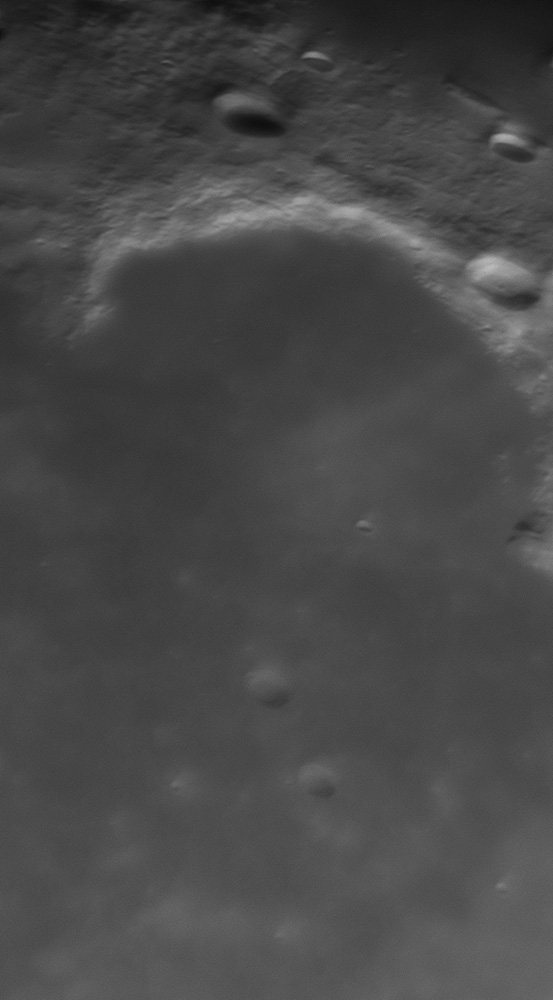
Very good view through the telescope when I looked at the moon the other week. At the top is Montes Jura, it surrounds the smooth lava bed Sinus Iridum (Bay of Rainbows) on the northwestern edge of Mare Imbrium (Sea of ​​Rain). A little to the south is the mountain range Montes Recti where the highest peaks reach a height of about 1.8 km (Latin for "Straight Mountains") is a distinctive, linear mountain range on the moon, located in the northern part of Mare Imbrium. Below are the mountains Montes Teneriffa (Tenerife Mountains) with individual peaks at heights of up to 2.4 kilometers. The crater Plato (in Swedish often called Platon) is one of the moon's most famous and easily recognizable impact craters. It is particularly famous for its dark, flat bottom and its location at the edge of one of the large lunar oceans. Plato has one of the darkest surfaces on the moon because it is filled with old, solidified basaltic lava. Astronomers like Johannes Hevelius once called it "The Great Black Lake"


måndag 5 januari 2026

Moonlit snow crystals


97% moon and the bright planet Jupiter next to it. In the cold snowy landscape, small crystals of different colors are seen in the snow taken with a macro lens. Even the two-bright stars Castor and Pollux are seen above the moon.
Snow crystals appear in different colors primarily due to light interference (thin films, prisms) or contamination, with thin-film interference causing iridescent blues, purples, and rainbow hues from light reflecting off layers, while contamination from algae (watermelon snow, green) or dirt/pollen creates vibrant reds, greens, and even blacks, altering the crystal's pure white appearance


måndag 29 december 2025

74% moon


Opened up the observatory and started to adjust the focus, connect the camera etc. and had just started taking pictures when heavy snowstorms came. But between these I was able to take pictures of tonight's moon which was 74% full. In the pictures you can see large craters like Copernicus, Plato, Archimedes and lava fields like Mare Imbrium with high mountain ranges Montes Alpes. Montes Alpes (Lunar Alps) is a prominent mountain range on the northern side of the moon, named after the Alps on Earth, and known for its highest mountain, Mons Blanc (3,600 m), and the impressive valley Vallis Alpes. The chain extends for about 220 km in a crescent shape, with a part bordering the lunar sea Mare Imbrium, and is one of the moon's most distinctive formations. Vallis Alpes is a lunar valley that divides the Montes Alpes area into two parts. It extends 166 km from the Mare Imbrium basin and trends east-northeast to the edge of Mare Frigoris. The valley is narrow at both ends and widens to a maximum width of about 10 km along the midsection. Copernicus is a prominent impact crater on the Moon located in the eastern Oceanus Procellarum. The crater is 96 km in diameter and 3.8 km deep. According to samples taken by Apollo 12 astronauts, the crater is about 800 million years old.


fredag 7 november 2025

Moon passing in front the sun

Earlier this year the moon passed in front of the sun and a partial solar eclipse occured. This was the view through the telescope, a closer look at the moons limb and the sun in Ha and an active area at the sun is visible.


Print @ webshop