Visar inlägg med etikett star. Visa alla inlägg

onsdag 16 september 2026

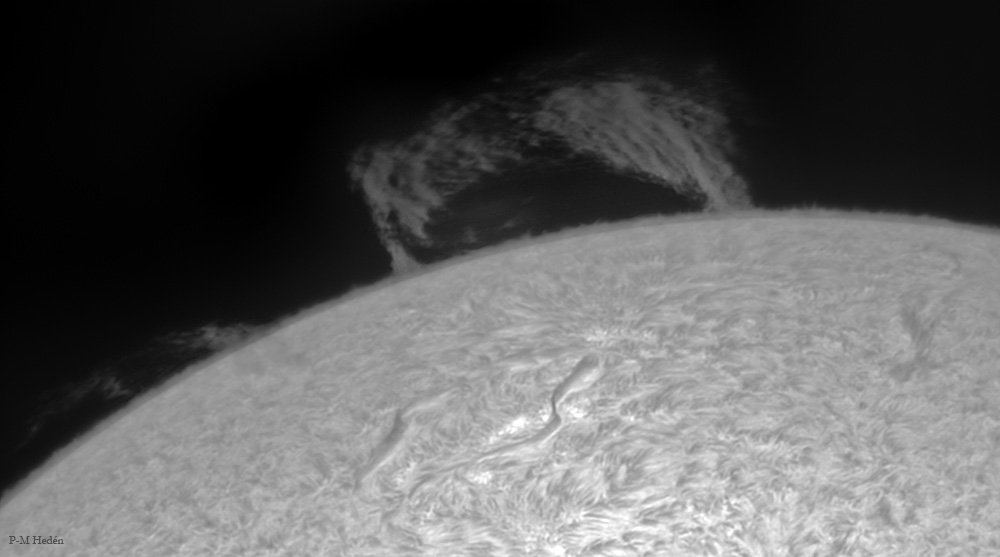
The chromosphere of the sun - high res photo.

The chromosphere is the thin middle layer of the Sun's atmosphere, located just above the visible surface (photosphere) and below the outer atmosphere (corona). It comes from the Greek word chroma, meaning color, because it shines with a bright red glow during total solar eclipses. The red color comes from glowing hydrogen gas, specifically the hydrogen-alpha (H-alpha) light wavelength. It extends roughly 2,000 to 4,000 kilometers (about 1,200 to 2,500 miles) above the solar surface. Unlike inner layers, it gets hotter as you move outward, rising from about 4,000 K near the bottom to 10,000 K (or higher) at the top. Possible to see/photograph: Spicules: Narrow, grass-like jets of plasma that shoot upwards from the bottom layer before falling back down.

Prominences and filaments: Huge, cool loops and clouds of gas held above the surface by magnetic fields. Visibility: It is normally hidden by the blinding brightness of the photosphere below, but it is visible during total solar eclipses or through special solar filters.

Photo taken with several photos stitched together as a high res photo of the sun.


måndag 18 maj 2026

Our star

Our beautiful star keeps our planet alive; without it there would be no life. On this warm sunny day the viewing was very nice, with a calm atmosphere and no major turbulence. The view through the eyepiece was fantastic! There was a lot of activity on the solar surface with active areas around sunspots and larger filaments. On the edge of the sun there were fantastic prominences; they were significantly larger than our own planet.


torsdag 14 maj 2026

The Sun 2026-05-14

Active regions on the Sun are temporary areas of intense, complex magnetic fields, often thousands of times stronger than the Sun's average magnetic field. They appear as dark sunspots in the photosphere and are the primary source of solar flares, coronal loops, and coronal mass ejections (CMEs)

Current Solar Activity (As of May 2026)As of May 14, 2026, multiple numbered active regions have been observed, including AR4436 and AR4438.Recent activity includes a strong M5.79 flare from region 4436 and associated radio blackouts.

Photos taken at Carpe Noctem Observatory.


fredag 1 maj 2026

AR4425

AR4425 (also known as 14425) is an active sunspot region currently located on the Earth-facing side of the Sun in late April and early May 2026. Here is the latest status of the region: Magnetic classification: It has recently been downgraded to a beta (β) configuration after losing its more complex "delta" structure, meaning its potential for powerful solar storms has decreased somewhat.

In recent days, AR4425 has been one of the more prominent regions, contributing to several C-class flares as well as occasional M-class (moderate) flares, including an M2.2 on April 26.

The region is currently moving across the northwestern quadrant of the Sun's disk. Although it has shown signs of decreasing complexity, it is still closely monitored by space weather services such as NOAA as it moves toward the edge of the Sun.


Photo taken through my back yard telescope 2026-05-01


lördag 25 april 2026

The sun in Ha 2026-04-25

Today's sun with quite a lot of activity. On the western edge of the sun, prominences are seen, also activity from sunspot 4422 which is just over the edge on the eastern side. On the surface, sunspots 4420. 4421 and 4424 etc. are seen with flares which are seen as white areas, also filaments, seen as dark streaks.

Sunspots are temporary, dark and cooler areas on the sun's surface (the photosphere) caused by strong magnetic fields. They arise because the magnetic fields inhibit the flow of energy from within the sun, making these areas cooler than their surroundings. The spots are linked to the sun's activity and are the starting point for solar storms.

And otherwise, structures in the chromosphere are seen via my Ha solar filter.

Without special equipment, the chromosphere cannot normally be seen due to the overwhelming brightness from the photosphere, but it is clearly seen through bandpass filters set to the H-alpha spectral line.