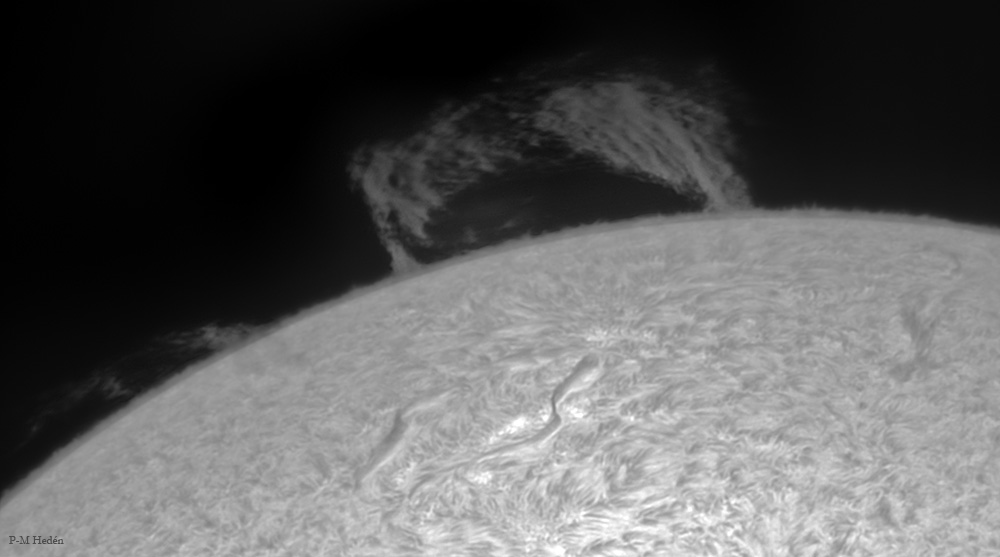
In solar physics, a prominence, sometimes referred to as a filament,[a] is a large plasma and magnetic field structure extending outward from the Sun's surface, often in a loop shape. Prominences are anchored to the Sun's surface in the much brighter photosphere, and extend outwards into the solar corona. While the corona consists of extremely hot plasma, prominences contain much cooler plasma, similar in composition to that of the chromosphere. Prominences form over timescales of about a day and may persist in the corona for several weeks or months, looping hundreds of thousands of kilometers into space. Some prominences may give rise to coronal mass ejections. Exact mechanism of prominence generation is an ongoing target of scientific research. A typical prominence extends over many thousands of kilometers; the largest on record was estimated at over 800,000 km (500,000 mi) long, roughly of solar radius. Photos taken back in 2022 using my Ha Solar filter and telescope.
Visar inlägg med etikett prominence. Visa alla inlägg
torsdag 21 maj 2026
lördag 11 april 2026
The Sun
Solar filaments are enormous arcs of dense, ionized gas (plasma) that float above the surface of the Sun, held together by powerful and intricate magnetic fields. They are part of the Sun's dynamic atmosphere and are closely linked to the phenomenon of prominences.
1. What is the difference between a filament and a prominence?
They are essentially the same physical phenomenon, but the name comes from perspective:
Filament: When the structure is viewed from the front against the bright solar disk, it appears as dark, thread-like lines. This is because the plasma in the arc is slightly cooler (and therefore less luminous than the hot solar surface (photosphere) behind it).
Protuberance: When the structure is viewed at the edge of the Sun (limb) against the dark background of space, it appears as a bright, glowing arc extending from the solar surface.
2. Properties and Formation
Structure: Filaments form along magnetic "neutral lines" where regions of opposite magnetic polarity meet. They consist of fine threads that follow the magnetic field lines.
Size: They can be hundreds of thousands of kilometers long, which is often significantly larger than the Earth or even Jupiter.
Lifespan: Stable filaments can exist for anywhere from a few days to several months before either collapsing or breaking apart. Sun photographed 2026-04-11 Carpe Noctem Observatory.
torsdag 4 augusti 2022
onsdag 3 augusti 2022
tisdag 2 augusti 2022
söndag 17 juli 2022
fredag 11 juni 2021
Partial Solar Eclipse part 2
Another shot taken 12.51 local time, the big filament is now behind the moon and the shadow is close to sunspot 2832. Orion 80ED, x2,5 Tele Vue Powermate, Canon Digital Rebel XT Hutech modified, expo 1/125s iso 100. This shot also shows the great prominence at the limb down right.
Prenumerera på:
Inlägg (Atom)