Visar inlägg med etikett airglow. Visa alla inlägg

söndag 28 december 2025

Giant crystals of feldspar and airglow


I´ve red about giant crystals of feldspar and small red gemstones of garnet in the rocks by the east coast of Sweden and really wanted to see/photograph them. For 1.9 billion years ago, there were explosive volcanoes there that spewed ash and lava over a shallow sea that covered the area. Early forms of life, microorganisms, lived on the seabed, which together built up limestone layers. Iron precipitated in the limestone and layers of iron ore formed, something that is common throughout Bergslagen. Deep below the volcanoes, large magma chambers have solidified into the rocks diorite and gabbro.

After a couple of hours of driving, I arrived at the port that was supposed to be near the place with the crystals. Then how to find them was another question. But I had looked at Google Maps and saw a trail that I could take and then turn off towards the coast. After a rather sweaty walk with heavy equipment, I was able to locate the outcrops where the crystals would be. a beautiful place with the sea right on the horizon. When darkness fell, I could see a nice starry sky with noticeable airglow, faint northern lights in the north and the Milky Way. After searching for the crystals with a headlamp in the dark for a couple of hours I finally found them and solved them with the UV lamp and the crystals fluorescent red in the dark – beautiful!!

onsdag 17 december 2025

Heavy airglow


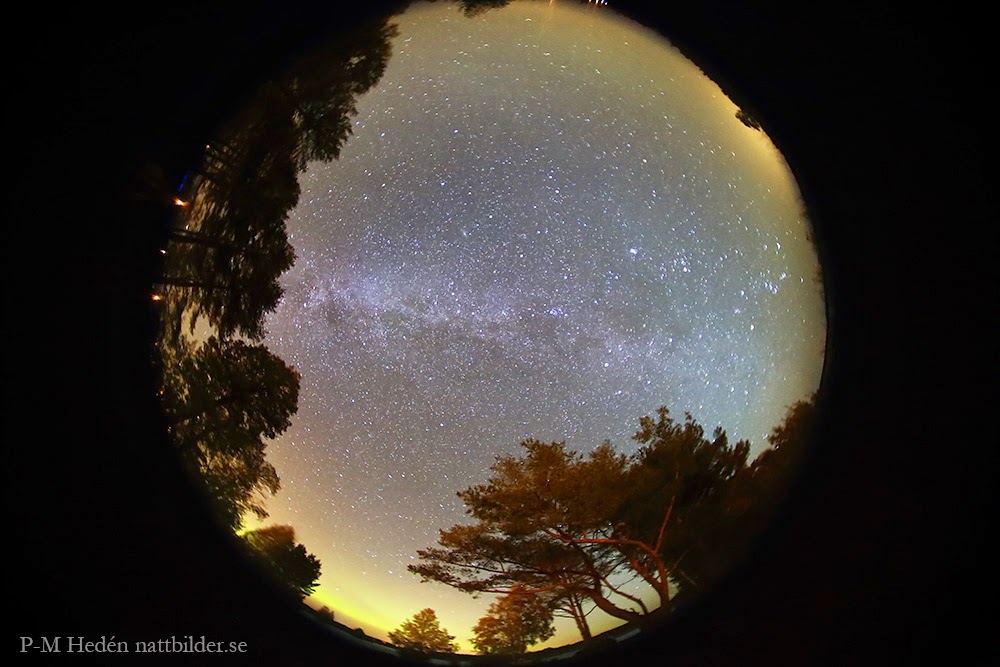
Amazing airglow by the coast last week. I could see it but not as much as in the photos.
Read about it here: Airglow - Wikipedia
And also some faint Aurora Borealis in the north, could see green band, actually two band and some pillars moving. In the middle of the panorama photo you have the Milky Way in Auriga/Perseus.


måndag 15 december 2025

söndag 14 december 2025

Orion rising


Bright planet Jupiter with the stars Castor and Pollux above (left), constellation Auriga and Taurus (middle) with the open cluster M45 Plejades (right), and constellation Orion rising from the ocean. Additionally, there is also heavy airglow visible to the naked eye. Airglow is a faint emission of light by a planetary atmosphere. In the case of Earth's atmosphere, this optical phenomenon causes the night sky never to be completely dark, even after the effects of starlight and diffused sunlight from the far side are removed. This phenomenon originates with self-illuminated gases and has no relationship with Earth's magnetism or sunspot activity, causing aurorae.

On planet Earth  

Feldspar, sometimes spelled felspar, is a group of rock-forming aluminium tectosilicate minerals, also containing other cations such as sodium, calcium, potassium, or barium. The most common members of the feldspar group are the plagioclase (sodium-calcium) feldspars and the alkali (potassium-sodium) feldspars. Feldspars make up about 60% of the Earth's crust and 41% of the Earth's continental crust by weight.

Feldspars crystallize from magma as both intrusive and extrusive igneous rocks and are also present in many types of metamorphic rock. Rock formed almost entirely of calcic plagioclase feldspar is known as anorthosite. Feldspars are also found in many kinds of sedimentary rocks.


lördag 13 december 2025

Airglow Aurora and Big Dipper


On planet earth you see fluorescence in water and lichens.

Airglow is a faint emission of light by a planetary atmosphere. In the case of Earth's atmosphere, this optical phenomenon causes the night sky never to be completely dark, even after the effects of starlight and diffused sunlight from the far side are removed. This phenomenon originates with self-illuminated gases and has no relationship with Earth's magnetism or sunspot activity, causing aurorae.

The Big Dipper is an asterism consisting of seven bright stars of the constellation Ursa Major six of them are of second magnitude and one, Megrez, of third magnitude. Four define a "bowl" or "body" and three define a "handle" or "head". It is recognized as a distinct grouping in many cultures. The North Star (Polaris), the current northern pole star and the tip of the handle of the Little Dipper (Little Bear), can be located by extending an imaginary line through the front two stars of the asterism, Merak and Dubhe. This makes it useful in celestial navigation.


fredag 12 december 2025

Ocean's purification plant and night sky

Mussels play a super important role as the ocean's purification plant by filtering enormous amounts of water, combating eutrophication (nitrogen/phosphorus), creating habitats (biodiversity) and providing healthy food for people (protein, vitamins), making them a climate-smart and nutritious resource for a sustainable future in Sweden's aquatic environments and other aquatic environments.

Ecological roles Water purification: Mussels filter plankton and particles, purify the water and combat eutrophication by binding nutrients such as nitrogen and phosphorus. Habitat and biodiversity: Mussel beds serve as protection and substrate for many small animals, which increases biodiversity. Key species in the food web: They connect benthic life with free aquatic life, and some freshwater mussels use fish to disperse their larvae.

Some mussels washed up at the shore a clear night by the coast. Faint Aurora and airglow visible in the sky in this macro widefield photo.


tisdag 28 oktober 2025

Latest high resolution prints in the webshop

Latest high resolution prints in my webshop www.nattbilder.se

Showing airglow by the sea and fluorescence seaweed.
Milky Way in a nationalpark
Fantastic Noctilucent clouds a summer night

Airglow: Airglow is a faint emission of light by a planetary atmosphere. In the case of Earth's atmosphere, this optical phenomenon causes the night sky never to be completely dark, even after the effects of starlight and diffused sunlight from the far side are removed. This phenomenon originates with self-illuminated gases and has no relationship with Earth's magnetism or sunspot activity, causing aurorae.


onsdag 26 augusti 2015

New photos from last weekend with my son

My sons favourite starcluster the Plejades M45 (Seven Sisters). This beautiful open starcluster is easily visible without optics, some might think it is the little Dipper because of the shape. This amazing cluster of stars lies only 440 ly away in the constellation of Taurus. These young stars (only 100million years old) will only stay together for about 250million years and then seperate and become individual stars in our galaxy. You can see blue instellar clouds around the stars in the photo. So it is a beautiful group of young stars that we can enjoy - so get out and do it Smiley smile! Canon 6D and 85mm lens.


Is it not amazing, to be able to see another galaxy without Optics! The galaxy of Andromeda M31 is a beautiful spiralgalaxy "only" 2,5 million ly away. If you know where to look you can see it without Optics At a dark location. Amazing, another Island of stars, probably another place with life and maybe someone is looking At our galaxy from there At the same way. If you look closely you can even see the satellite galaxy below it. Now, you don't see the galaxy like in this photo, the sensor in the camera capture much more, but you will see it as a fuzzy dim oval object in the sky. Photo taken with 85mm lens and Canon 6D.


Airglow and milkyway shots..


lördag 15 augusti 2015

Perseid Meteorshower 2015 and Starry sky photos

Staying at the beautiful island of Gotland Sweden on vacation with my family. Of course we stayed during the Perseids which were taking place during great conditions with no moonlight. We choose the location at Holmhällar ancient coralreef called Raukar just by the ocean with dark sky in the south. One night we counted around 200 meteors during 2,5 hours. The Milkyway looked like a long cloud in the nightsky and amazing many stars. Me and my son Olle saw a Bolid too, low in the north like a firework in the sky, green and fragments falling behind - Beautiful!!
Of course I went around in the night photographing the starry sky too, one night the airglow were amazing, we saw the green colors!
And back home in Vallentuna with lightpolluted skies I captured another Perseid last night above Carpe Noctem Observatory


måndag 29 september 2014

Stargazing weekend

What a great weekend by the cabin, lovely nightsky with faint Aurora Borealis and meteors, great Milkyway and great company, my family went along and joined me.
My children looked at M31, M45 and the double cluster with binoculars and it was a great view.