Visar inlägg med etikett galaxy. Visa alla inlägg

tisdag 6 oktober 2026

Andromeda galaxy

Did you know you can see a galaxy with the naked eye? It’s true, though you do need a dark, clear sky free of moonlight. You can make it out with the naked eye if you know where to look. As someone who’s been at this a long time, I use a trusty star atlas, but nowadays there are apps you can download for stargazing. Viewed through a small pair of binoculars, it is a spectacular sight. The Andromeda Galaxy—as it is known—lies about 2.5 million light-years away in the constellation Andromeda. It is a spiral galaxy containing billions of stars, much like our own galaxy, the Milky Way. These galaxies may eventually collide, as Andromeda is moving toward us, though that is a long way off; the predicted collision between Andromeda and the Milky Way is expected to occur in roughly 2–5 billion years, resulting in the formation of an elliptical "blob" galaxy dubbed "Milkomeda" or "Andromeway." This so-called "collision" is expected to be more of a gentle merging than a violent smash-up—it must be an amazing sight in the sky!

The image is a single 15-second exposure. 


lördag 18 juli 2026

Milky Way

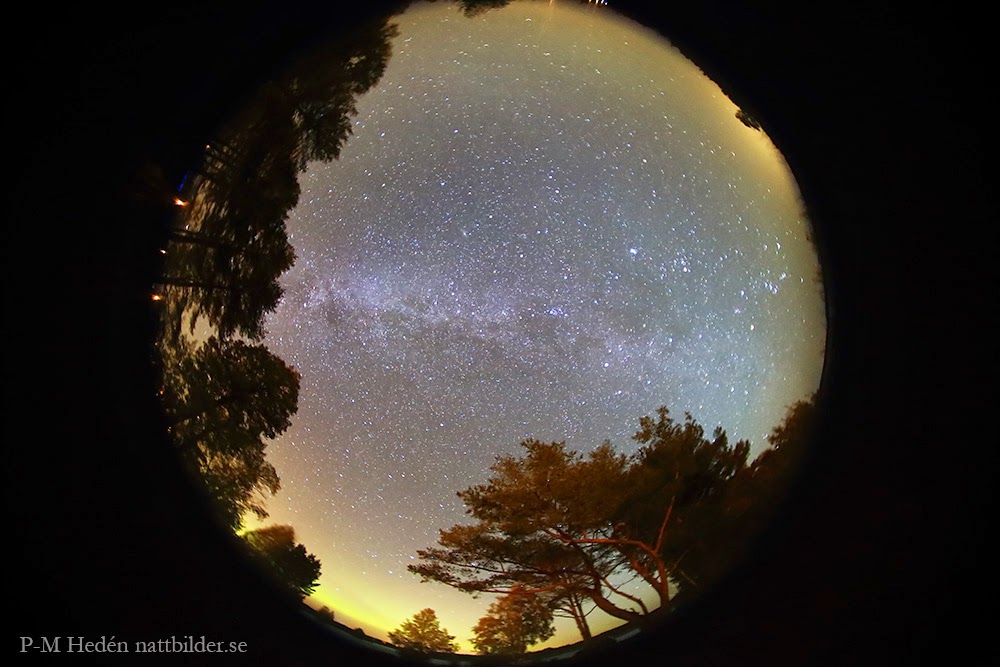
Imagine being able to see our own galaxy, the Milky Way, with the naked eye. But you have to get away from all light pollution, away from cities and even local lights. The moon must not interfere either. Wait to get night vision (10-40 min), no lamp on or mobile phone on - then you will see the Milky Way as a band across the sky. These pictures were taken in Gekland and there you can also see the center of the Milky Way, which is seen as a large cloud in the night sky. This part of the Milky Way cannot be seen from Sweden.

The center of our galaxy is located 26,000 light-years away from Earth in the Sagittarius constellation. It features a supermassive black hole called Sagittarius A*, which is about 4 million times heavier than our Sun. Thick cosmic dust hides this busy, star-packed region from normal view.

Astronomers estimate that the Milky Way contains between 100 and 400 billion stars. Because we are inside the galaxy and obscured by thick clouds of gas and dust, we can only roughly calculate the total by measuring the galaxy's mass and observing the movement of its stars


söndag 26 april 2026

Center of our galaxy

The center of our galaxy rises from the ocean late at night off the east coast of Sweden. The center of the Milky Way is the dense core of the galaxy, located about 25,000–28,000 light-years from Earth in the constellation Sagittarius. At its absolute center is the supermassive black hole Sagittarius A* (not visible in these photos, still under the sealine), which weighs about 4 million solar masses. The area is hidden behind thick space dust and is characterized by an extreme density of stars. 


fredag 17 april 2026

Me and the Milky Way

Standing in dark conditions and making sure to get night vision with the Milky Way over the sea is a beautiful sight. Seeing the dust clouds of our galaxy the Milky Way visually is a fantastic experience. This picture was taken last Saturday night with myself standing on a cliff looking over the Baltic Sea.

Light pollution threatens the night sky and wildlife and all the satellites are also destroying the night sky. what will we see in the future when we look up at the starry sky? Will this view be gone? This week is International Dark Sky Week https://darksky.org/ check out the website and help to protect the night sky.


onsdag 12 november 2025

TBT S:t Olofsholm Öland 2008

Going through photos and it is a lot of years now, from 1999 when I started my astrophotography. Found this old photo from 2008 of a lovely windmill by the sea of the island of Öland in the area of S:t Olofsholm. And what a night sky!


New in webshop


söndag 3 januari 2016

My favourite photos from 2015


Amazing Northern lights displays during 2015. three times I witnessed Aurora corona above my own house in Vallentuna 30km north of Stockholm - amazing!


East coast Aurora with faint Northern lights in September.


Another Corona of Aurora above my house!


A great Perseid meteorshower at Holmshällar Gotland Sweden.


A nice Geminid meteorshower at the cabin by the Dalriver.


My dear parents enjoying the Andromedagalaxy.


Three planets conjunction early in the morning.


Great Aurora in the heart of Stockholm!


Starry sky at Färnebofjärdens nationalpark


Showing comet Lovejoy to my son.


Winter scenery with Milkyway and my son.

fredag 25 september 2015

Andromedagalaxy


Kind of amazing, to see another galaxy 2,5 million lightyears away without optics! You will see it as a fuzzy oval object during clear dark nights.

onsdag 26 augusti 2015

New photos from last weekend with my son

My sons favourite starcluster the Plejades M45 (Seven Sisters). This beautiful open starcluster is easily visible without optics, some might think it is the little Dipper because of the shape. This amazing cluster of stars lies only 440 ly away in the constellation of Taurus. These young stars (only 100million years old) will only stay together for about 250million years and then seperate and become individual stars in our galaxy. You can see blue instellar clouds around the stars in the photo. So it is a beautiful group of young stars that we can enjoy - so get out and do it Smiley smile! Canon 6D and 85mm lens.


Is it not amazing, to be able to see another galaxy without Optics! The galaxy of Andromeda M31 is a beautiful spiralgalaxy "only" 2,5 million ly away. If you know where to look you can see it without Optics At a dark location. Amazing, another Island of stars, probably another place with life and maybe someone is looking At our galaxy from there At the same way. If you look closely you can even see the satellite galaxy below it. Now, you don't see the galaxy like in this photo, the sensor in the camera capture much more, but you will see it as a fuzzy dim oval object in the sky. Photo taken with 85mm lens and Canon 6D.


Airglow and milkyway shots..


måndag 16 mars 2015

Aurora by the eastcoast

Another trip, this time to the eastcaost north of Norrtälje. We hoped for some Aurora and we got some, not the strongest but a nice display. My parents joined me and enjoyed the Aurora with the starry sky and the Andromedagalaxy, the most distance object you can see without optics during a dark and clear night, 2,5 million lightyears away.


fredag 3 oktober 2014

Galaxy NGC 891

Maybe someone out there is looking at our galaxy Milkyway like this..
NGC 891 lies in the constellation of Andromeda and the distance are around 30 million ly away.
Photo taken with a Celestron NexStar11 GPS @ 2800mm and Canon 600D in Carpe Noctem Observatory, guiding through Orion 100ED and Lacerta Stand Alone Guider.
Expos at iso 800 1600 3200 and 6min each, totlally around 90min.


måndag 29 september 2014

Stargazing weekend

What a great weekend by the cabin, lovely nightsky with faint Aurora Borealis and meteors, great Milkyway and great company, my family went along and joined me.
My children looked at M31, M45 and the double cluster with binoculars and it was a great view.