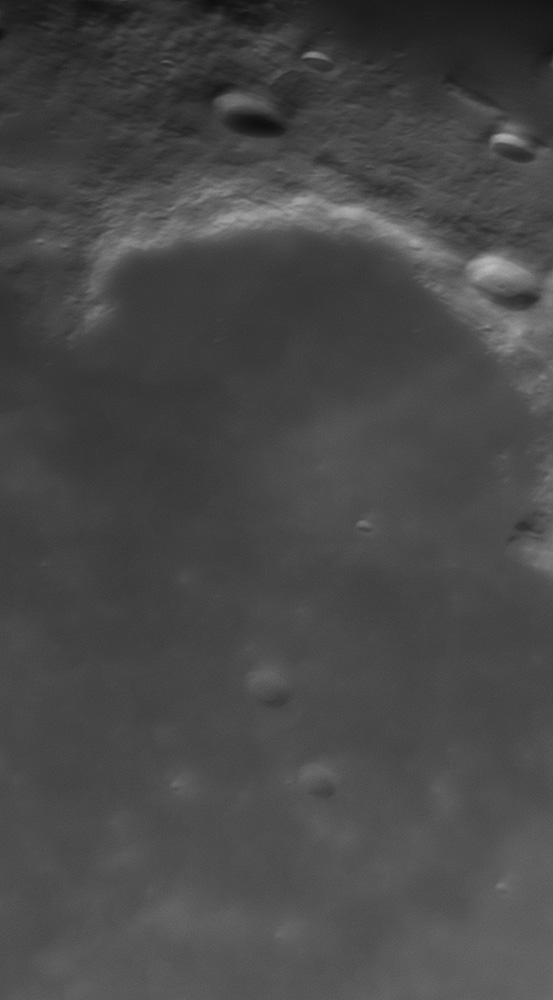
A very low moon in the sky, barely visible from the observatory. I didn't think there would be any sharp pictures but they turned out better than I thought. I just managed to take a picture of the moon before it disappeared behind the trees.
The close-up shows the crater Gassendi is a large lunar impact crater feature located at the northern edge of Mare Humorum. The crater was named after French astronomer Pierre Gassendi by the IAU in 1935.


Today's full moon, called a worm moon, photographed with a telescope and several images stitched together into one image.
At a full moon, the sun illuminates the lunar surface directly from the front, which hides shadows and makes it more difficult to distinguish topographical details such as craters and mountain walls. The use of HDR photography (High Dynamic Range) and stacking (combining many images) is therefore crucial to highlight geological contrasts and mineral variations that are otherwise lost in the bright light.
Geological details at a full moon
Beam systems: At a full moon, bright beam systems appear most clearly, for example from the crater Copernicus. These consist of material (ejecta) that was thrown out during a meteorite impact.
Albedo and minerals: The contrast between the light, calcium-rich highlands (anorthosite) and the dark, iron-rich oceans (basaltic maria) becomes extremely clear. By saturating the colors in an HDR image (so-called "Mineral Moon"), chemical differences in the soil can be visualized.
Bright Craters: Craters with high albedo, such as Aristarchus, shine brightly and can even be seen with the naked eye.

A quick visit to the Carpe Noctem Observatory tonight. It cleared up and I managed to take a quick photo of the moon before fog clouds ruined the session.
The picture shows beautiful mountain ranges on the right side of the Mare Imbrium lava field.
The top mountain range is the Montes Alpes, one of the most distinctive mountain ranges on the moon, located between Mare Imbrium and Mare Frigoris. It stretches for about 250 km and is best known for being literally split in half by an enormous valley.
Important peaks and landmarks
Mont Blanc: The highest point of the mountain range, located on the eastern side, with an altitude of about 3,600 meters. The name is taken from the highest mountain on Earth in the European Alps.
Vallat Alpes (Alpine Valley): The most spectacular formation in the area. It is a straight, 166 km long and about 10 km wide trough that cuts straight through the chain. It is a favorite for amateur astronomers to observe.
Promontory Agassiz: A headland at the southern end of the chain, rising about 2,300 meters.
Below the Alps and the Caucasus Mountains" most often refers to the lunar mountain range named after the Caucasus Mountains on Earth. These mountains lie on the northern part of the lunar far side and form a boundary between Mare Imbrium and Mare Serenitatis.
Peaks of the Lunar Montes Caucasus
Unlike Earth's mountain ranges, most individual peaks in the lunar Montes Caucasus do not have official names.
Highest peak: The highest point reaches an elevation of about 6,000 meters (19,000–20,000 ft) above the surrounding lunar surface.
Geographical location: The mountain range extends for about 445 km and is located near prominent craters such as Aristillus, Autolycus, and Calippus.
Below lies the beautiful Montes Apenninus mountain range, the most impressive mountain range on the lunar far side. It extends for about 600–950 km and forms the southeastern rim of the giant impact hole Mare Imbrium.
The Most Prominent Peaks
Here are the highest and most famous named peaks in order from north to south:
Mons Hadley: A massive peak at the northern end of the range, with an elevation of about 4,500–4,800 meters.
Mons Hadley Delta: Located south of Mons Hadley and is about 3,500–3,600 meters high. The valley between these two mountains was the landing site of Apollo 15 in 1971.
Mons Bradley: Located further south with an elevation of about 4,200 meters.
Mons Huygens: The highest peak of the range (and often considered the moon's) rising about 5,300–5,500 meters above the surrounding plains.
Mons Ampère: A peak west of Mons Huygens with an elevation of about 3,000 meters.
Mons Wolff: Marks the southwestern end of the range near the crater Eratosthenes and reaches about 3,500 meters